Yang and Yin: 5 Fundamentals on repeat
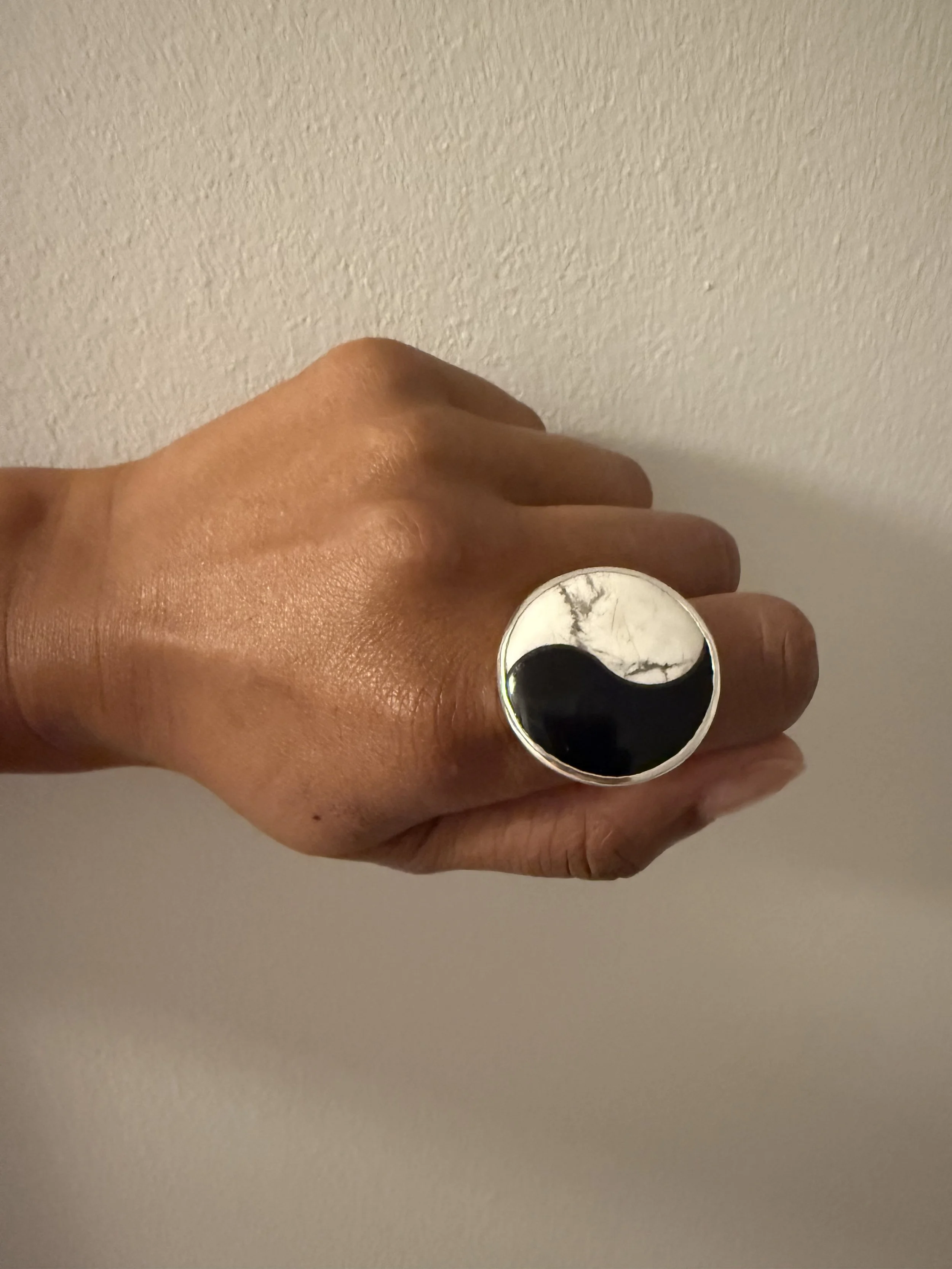
I grew up in the depths of Somerset during the early 90s, when there weren’t many shops to choose my burgeoning teenage identity from. It’s not surprising that upon seeking an alternative, one such shop is always present in every town. Tucked down a terribly graffiti-covered alleyway, this one was called Caves. It was the kind of shop that sold the ‘alternative’ clothing a teenager would adorn to instil fear in their parents, when experimentation and questioning ideals is mandatory, and it was here that I first discovered the yin-yang symbol.
There was a basic knowledge applied to what it meant in those days. It represented non-traditional thinking, good/evil, dark/light and a western person who might have carried a ‘hippy’ eastern disposition, insinuating an interest in healing ‘arts’. I also took its meaning to represent this, and over the years, following its saturation in the West, its symbolism tips into ‘mainstream hippy’.
30 years or more later, I now don a ring with this symbol, which I have now come to know as TaiJiTu, the Diagram of the Supreme Ultimate.
Tai: Supreme
Ji: Ultimate/Upright/Polarity
Tu: Diagram
(This is a translation I adore for its inferred stature.)
This ring is infinitely more refined and elegant than the thin cotton yin/yang dungarees that hung from the rails in Caves, alongside the marijuana leaf T-shirts and bongs. To me, this ring represents the evolution of my understanding of yin/yang as a woman swiftly approaching my 50s, along with the carriage of experience that has brought me here.
These are the 5 fundamentals of yang and yin that are slowly integrating within me:
They are opposites.
This seems obvious, but we must state the obvious repeatedly for it to land differently. Examples that spring to mind are night/day, rest/activity, male/female. Their opposition creates both balance and tension.
But we need them both. (Special nod to the male/female analogy in current times).
Opposites will also mean they are complementary and contrasting. The qualities of yin are no more important than the qualities of yang and vice versa. Read that bit again.Interdependence.
Referring back to contrast, because without contrast, neither could exist.
They are not absolute values; their values are based on each other as a comparison. They rely on each other. If there were never darkness, we would not know what lightness was. A very fundamental reason why if we can learn to appreciate the negatives, our positives are experienced more deeply also.Mutual Consumption.
They dance with dynamic balance, as one increases, the other decreases. This is the elegance in the simplicity of the TaiJiTu. As Chinese Medicine practitioners, we also have a permanent overlaying of the clock onto this symbol branded in our memories. This is to see where the yin is growing (the black, the night) and when the yang is shrinking (the white, the day) and vice versa. This does not, however, mean there is a finality in the overall quantity; this is a relative measure of a larger cycle that is occurring concurrently.
Inter-transformation.
They transform into one another. This is a biggie. This is when something turns into something else. This appears like a simple concept, but it makes my eyes do that thing when you are working out a complicated maths question in your head, somehow looking upwards, left and right, as if the answer is up there somewhere.
In the extreme of night (yin), yin transforms into the beginnings of day (yang). But it has to be at the extreme. I think that this is the most difficult one to grasp fully, if one is even capable of such a thing. This is the part of Daoist philosophical thinking that I find the most fascinating and wish to explore to a pathological depth: the exact moment when an energy ceases to have its ‘own’ qualities and decides to adopt another bunch of qualities. The precise moment of change and the conditions that allow this to happen.Because without this magic, and it is MAGIC, there would simply be no existence as we experience it. I think what I’m describing is called alchemy.
Infinite Divisibility.
There is a tiny aspect of yang and yin that my beloved new jewellery does not demonstrate. It does not have the opposing small dots within each fullness. This is a very important detail. It demonstrates that within yin, there is also a seed of yang, and within yang, there is always a seed of yin. Everything holds within it an element of both. For example, water is considered yin, and fire is considered yang. But if we zoom in on water, water in a lake form is yin, and water in a river is yang. If fire is considered the most yang aspect of nature, divided into 2 further aspects would see the dynamic movement and light of a bonfire as the yang, unpredictable and expansive. And the yin aspect of fire is the nourishing heat, the warmth that encourages joy and vitality. It is infinitely divisible far beyond human comprehension.
Many times, I am asked to explain how acupuncture works, and although there are many, many ways to attempt this explanation, it repeatedly returns to understanding the fundamentals. Fascination occurs for me when, upon return to these fundamentals, with them are brought a slightly different meaning, not necessarily increased depth, but a differing quality. May I boldly assume that this happens because each time they are brought to me, I am a slightly different receiver?
I‘m certainly not the same receiver as the 12-year-old who set foot into Caves all those years ago. So forgive me, for now, l may mostly be found pondering the fundamentals, as much as sense allows before it tips into pathological. It’s about balance after all.
Living in the frame of the TaiJiTu may be to find balance, not in stillness, but in the graceful movement between opposites.
Ring design: www.aliceeden.co.uk